

What Is a Drop? Why Streetwear Collections Arrive in Pieces
Streetwear collections don't land in one launch — they open as small groups spread across weeks. Where that release model came from, why a single drop holds three to ten pieces, where the stock goes once a drop closes, and what reading the shop calendar is actually good for.
Two weeks apart, most of a shop floor looks identical. The wall rails hold their order, the denim corner stays put, and the only thing that has actually moved is the table near the entrance — five or six pieces on it, swapped out. In streetwear that swap is called a drop, and a collection arriving in pieces rather than all at once isn't a delay. It's the release model the whole thing was built around.
The working definition is simple: instead of putting an entire season on the floor in one launch, a brand opens it in small groups spread across weeks or months. Each group is a finished idea on its own. None of them is the season.
From two seasons a year to a weekly release
Ready-to-wear ran on two calendars for decades — spring/summer and autumn/winter. The collection closed months ahead, production ran in bulk, and the shop built its floor once at the start of the season. That rhythm belonged to businesses working with high volume and long lead times.
Streetwear never came from there. Skate labels, merch tables set up at the back of a venue after a show, two-person print shops — none of them had the capital or the calendar to close a full season. They produced with whatever was on hand: twelve tees, one case of caps, and when that ran out, the next thing. What large brands have since turned into an institution started as a constraint. Small production runs let a label change direction with every group; an idea that works in October doesn't have to be repeated in November.
How many pieces a drop actually holds
Usually somewhere between three and ten, and that number comes from the factory floor rather than the marketing meeting. Running one embroidery pattern, one knit structure, or one wash means setting the machine up once — and the wider the group gets, the more that single setup falls apart.
Different scales of this are sitting on the floor right now. The three-piece run of mountain and creature knits is the small end: one loom setup, three colors. The set of jeans built on four separate washes sits in the middle, where the variable isn't the pattern but the finishing. The wider run carrying both hoodies and tees is what it looks like when two ideas land on the same calendar — past ten pieces, and structured differently as a result.
Why the theme comes before the product category
A drop isn't assembled by category, it's assembled around an idea. A shop floor is organized the other way — caps together, tees together — so a drop cuts across it. One group can hold a tee, a hoodie and a cap at the same time, because what those pieces share isn't their type but the work printed or stitched on them.
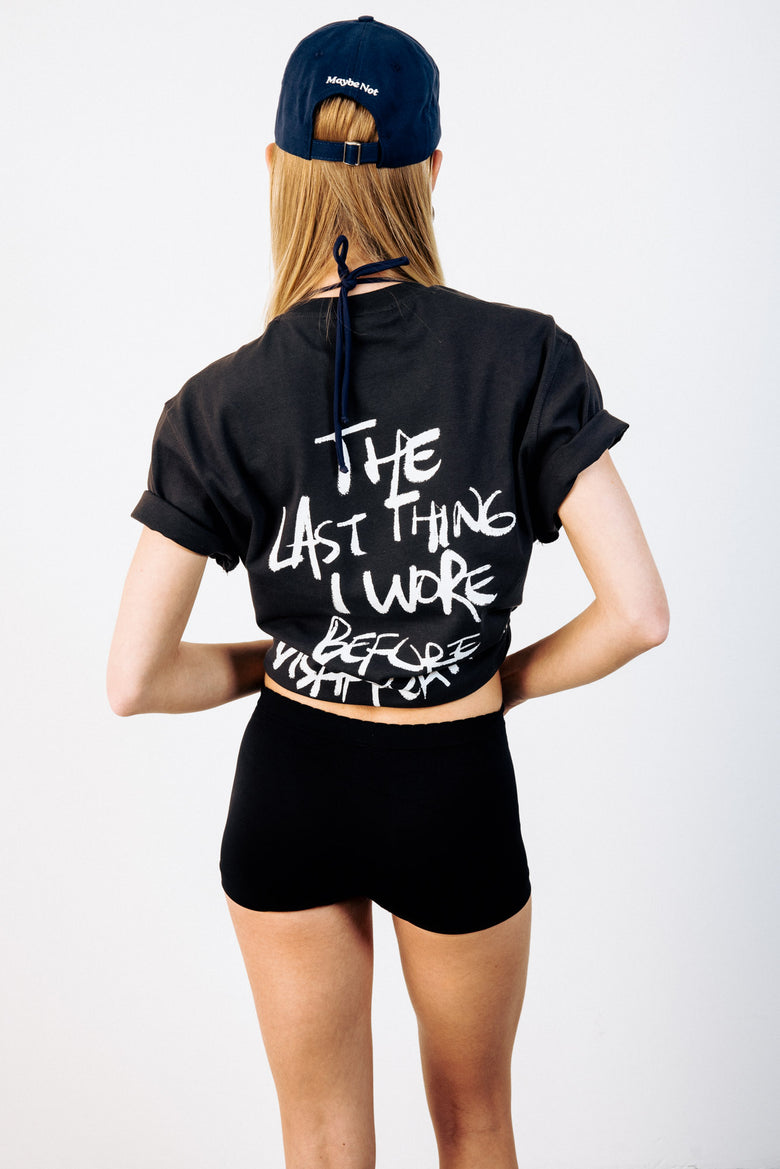
That's why the group that carries one phrase from tee to cap manages to do three different things with a single word. The run the rabbit and luck motifs share is put together the same way: the raised-print black tee and the hoodie from the same line aren't alternatives to each other, they're a continuation. Take one piece out of the group and the idea doesn't break — it just reads quieter.
Headwear works on the same logic. The off-white Tutto Passa cap is the smallest and most portable thing in its run, and it goes into an outfit without the rest of the group behind it.
The continuous line that sits outside the calendar
Not everything is tied to this schedule. Jeans, plain tees, logo socks, an unbranded hoodie — pieces whose demand doesn't swing with the season — run on what the trade calls carryover: same pattern, same fabric, reproduced as it sells through. Drops rotate around them while they stay where they are.
The denim line that keeps running on the same block season after season is the clearest case of this; the black denim jacket was on the floor with that exact cut two years ago. The basics that hold their place year-round are planned the same way — the grey marl hoodie, the dark navy loose fit jeans, the black logo socks — the layer underneath whatever drop lands on top of it.
In practice the two lines do different jobs. The continuous line builds the skeleton of a wardrobe; a drop adds the thing that belongs to this particular month.
Where the stock goes once a drop closes
When a group's release window ends, the pieces don't vanish. They split three ways, and the shop pages keep those routes separate.
Back into production
Pieces that outrun their forecast, and whose patterns can be run again, return with the same specs. What shows up under pieces that went back into production and returned to the floor isn't technically a new drop — it's a closed group continuing.
Broken size runs
Middle sizes clear in the first weeks and the ends of the range stay. At that point a piece no longer offers a full run, and groups with broken size runs get collected somewhere separate.
Lines that close for good
Then there are the ones that never come back: a one-off embroidery, a single production run out of the leather line, a print tied to a moment. This is more common where the handwork is heavy — something like the baby blue mountain knit, where the loom gets set up once and isn't set up again.
Why a new color isn't a new drop
Two things get mixed up constantly: opening a new group, and adding a color to a pattern that already exists. The second one is a colorway, and on the production side it's a far smaller piece of work. The block is done, the construction is done; the only variable is the shade of the fabric or the yarn.
So colors added to existing patterns live under their own heading. The off-white Overthinker cap isn't a new idea — it's a second tone of something that already came out in black. Knowing the difference is useful: once you've learned that a block fits, there's no sizing question left in its next color.
Reading the shop calendar
The Teşvikiye store and the website run on the same calendar but read differently. A window shows you the group that's current; online, the groups sit stacked on top of each other. The most recently opened group tells you the idea of the month, while everything newly on the floor pulls together the new group, the restocks and the added colors all at once. They're not the same page, and the gap between them is what tells you how long a given piece is likely to stay reachable.
Across the Nişantaşı and Teşvikiye concept store strip this calendar also sets the pace of the room itself: caps and tees turn over fast, while the knitwear and sweatshirt and hoodie side is measured in months. If you follow Istanbul streetwear at all, separating those two speeds is what makes it clear upfront what can be waited for and what can't.
Drops get explained as a mechanism for urgency, but the actual function is calmer than that. Small runs give a label room to change its mind, and they let a shop spread its floor across the whole year instead of two openings. For anyone who knows the calendar, the payoff is straightforward — working out which pieces will still be there next year and which ones belong to this month stops being guesswork.

