

What Does 'Concept Store' Actually Mean? The Shelf Logic of a Nişantaşı Streetwear Shop
"Concept store" gets used constantly and defined rarely. Why a book and a wall clock sit beside the t-shirts, how a selection gets narrowed down, and the order worth walking the shop in. Inside the shelf logic in Teşvikiye.
"Concept store" has been used so loosely in Istanbul that it has stopped describing anything. Any shop with two plants in the window now calls itself one. There is a real working method underneath the phrase, though, and the clearest place to see it is the shelf itself: in a concept store, products are arranged in relation to each other rather than by category.
What follows is a plain account of how the Teşvikiye store is put together. Part answer to "what is actually in here", part explanation of how a selection gets narrowed down.
Category shops versus selection shops
A conventional clothing shop runs on category logic: the tee section carries as many tees as possible, the hat section as many hats as possible. The goal is coverage. Depth exists so that whatever a customer comes looking for is there.
A selection shop does the opposite. It sells decisions instead of coverage. There are around a dozen caps on the wall right now, and that number has nothing to do with supply. Each model does something the others don't: one carries a plain logo, one an embroidered sentence, one is light enough to be the single break in an otherwise dark outfit. When two models start doing the same job, one of them doesn't get ordered.
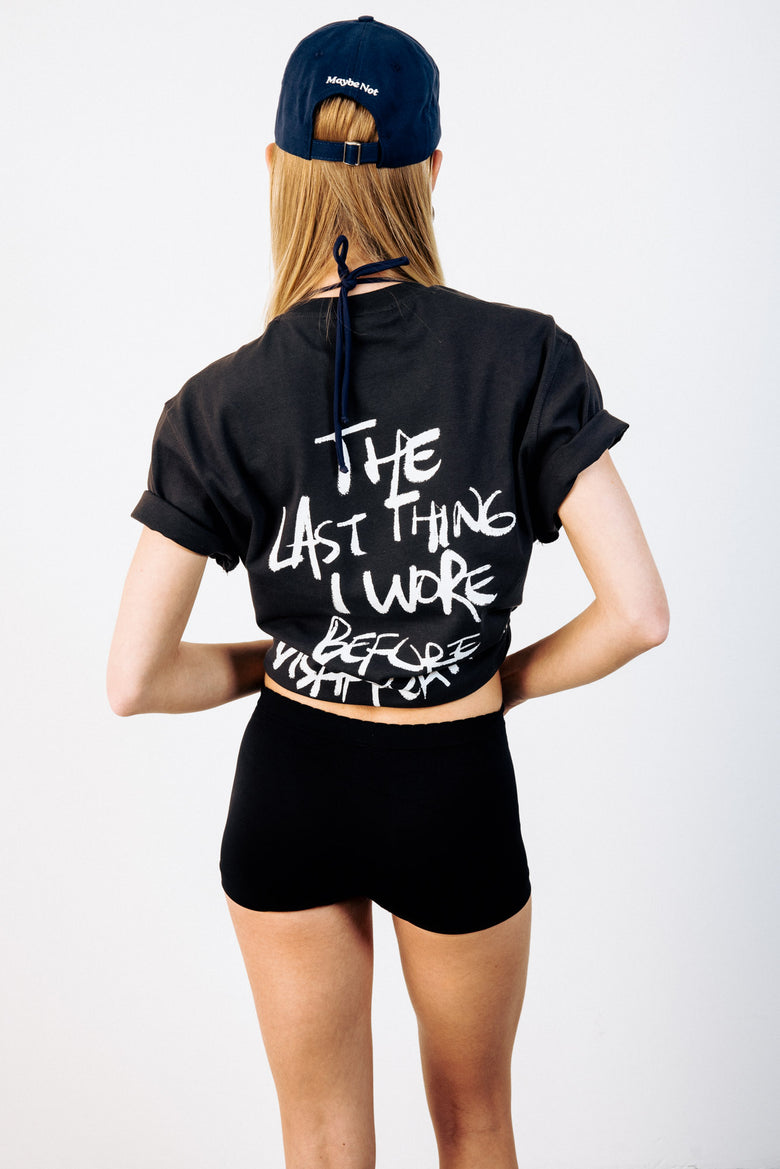
The same rule applies to tops. The t-shirt side isn't built as a print archive but as a handful of weights and a handful of ways of speaking: plain logo, graphic, text. Which one leads an outfit is a decision left to the customer, not made by the rail.
What is a book doing next to a t-shirt?
This is where first-time visitors usually stop. There is a shelf of books beside the clothing, and those books aren't set dressing. They're stock.
The reason is straightforward: a brand's references don't only show up in fabric. A book on design and typography like Works and Words draws on the same source as the choice of letterform on a tee. Titles such as Politics of Study or The Obsessed say something else too: there's a reading list behind the rail, not just an outfit.
The shelf also changes what the room is for. Someone who stays ten minutes to flip through a book spends those ten minutes actually looking at everything else.
What really defines a selection is what isn't in it
The character of a selection comes less from what made it onto the shelf than from what didn't. Three things get left out here.
First, pieces reinvented every season for the sake of it. The core line stays broadly the same year to year, because the cut and the weight already work. Second, products that only look good in a photograph. Third, a near-copy of something somebody else already does better.
What does earn a place is work that arrives in small numbers. The knitwear, where the pattern is knitted rather than printed, and the hand-finished silver jewellery are both here for that reason. Neither suits large production runs, which is why you rarely run into them elsewhere.
A sensible order to walk the shop in
A practical suggestion: look at the wall first. The caps are there, and because they're the fastest-changing part of an outfit, they set the tone of the selection quicker than anything else. Then move to the centre table, where the tees, the socks and the smaller objects sit. Everything non-clothing, from keyrings to a wall clock, collects on that table.
The hanging rail deserves slower attention: hoodies, knits, shirts. Deciding without trying things on is difficult here, because most of the cuts are loose and a single size difference rearranges the whole silhouette.
Leave the leather pieces and the leather bags for last. They're the products that lose most on a screen, since surface texture and weight don't survive photography.
Is the site the same selection as the shop?
Largely, though not exactly. The collections online follow the same shelf logic, with the same pieces grouped the same way. The difference appears in size and colour depth. A size missing in store on a given day may well be sitting on the site, and occasionally the reverse.
Using both is the efficient approach: settle the cut and the fabric in person, then complete the colour or the second size online. That's most noticeable across hoodies and sweatshirts, where colourways of the same model cycle through stock in turn.
Where the shop is
Hüsrev Gerede Caddesi No:78, Teşvikiye. Just off the main Nişantaşı retail strip, a short walk away.
What the shelf is saying
A concept store is really making a claim: these things belong together. If a book, a t-shirt, a silver ring and a wall clock share a room, what connects them isn't a category but a single point of view. Whoever is looking at the shelf either takes that view or leaves it, and either way the shop has told you what it is.
For anyone hunting down a concept store in Istanbul, the useful question isn't how many brands are stocked. It's who made the choices, and on what basis. The answer isn't in the window. It's on the shelf.

