

Styling Knitwear: Chunky, Fine Gauge and the Vest Play by Different Rules
It isn't the colour of a sweater but its gauge that decides where it sits in an outfit. Three separate sets of rules — chunky, fine gauge and the knit vest — from the tee underneath to the line at the ankle.
Gauge — how thick the yarn is and how tightly it has been knitted — never appears on a label, but you register it the second you pick a sweater up. Two knits can share a colour, a size and a price tag, and still refuse to do the same job in an outfit: one built from heavy yarn in a loose knit, the other fine and densely worked. By late September, when knitwear moves to the front of the wardrobe, the question people ask is usually about colour. The decision that actually shapes the outfit happens one step earlier, in the knit itself.
What gauge translates to in a wardrobe
A chunky knit means volume: width across the shoulder, fullness in the sleeve, a surface that holds its own shape. It resists anything worn over it and forces whatever goes under it to get thinner. A fine gauge behaves almost like a shirt layer — it slides over a collar, sits under a jacket, and lets you keep stacking.
So the useful question in a fitting room isn't whether a sweater suits you, but where it will sit in the outfit. Chunky pieces tend to be the outermost layer; fine ones are middle layers. The knitwear selection may live on one shelf, but that's where the two part ways.
Chunky knits: when the weight sits up top, the bottom half goes quiet
A full-bodied sweater pulls the centre of gravity upward. Repeat that same volume below and the whole outfit inflates — a loose knit over loose sweatpants reads as mass rather than shape. The balance comes from keeping the lower half flatter and more legible.
The baby blue Mountain sweater is a good test case: the colour is already light, the knit already heavy, so it works best when nothing below competes. Dark denim or plain black trousers will look like they're doing nothing next to it, which is exactly the point — a pair of black loose fit jeans, or the more washed-out Shadow Stone, both take that role.
The second thing to watch on a chunky knit is sleeve length. Heavy yarn keeps stretching under its own weight; the cuff creeps past the wrist and the hand disappears. Swinging the arm down once while trying it on shows you where the sleeve really ends, not where it sits when you stand still.
Fine gauge: the only knit that genuinely works over a shirt
Wearing a sweater over a shirt tends to work when the knit is fine. Under a chunky one, the collar bunches, the shoulder line breaks and the shirt itself gets crushed. A finer knit lets the collar and cuffs stay visible, so two different surfaces read at the same time.
In that setup the shirt matters more than the sweater. Something plain and long-sleeved — the black Signature shirt, for instance — adds a clean line where the collar rises above the neckline. Try the same thing with a patterned shirt and the two surfaces start competing; the difference is easiest to judge with the shirts side by side.
A knit vest is doing something else entirely
A vest isn't a sweater, it's a layering device. With no sleeves, it leaves whatever is underneath visible from the elbow down and frames the torso instead of covering it. Worn on its own it exposes the shoulder line, which is why the tee underneath needs its shoulder seam sitting where it should.
A dark piece like the navy Signature knit vest builds its own contrast once something lighter goes under it. In a stretch of the year when the temperature shifts twice between morning and evening, the vest becomes the thing you reach for at the hours when a full sweater is too much.
Why the weight of the t-shirt underneath matters
Put a heavy t-shirt under a knit and the two fabrics push against each other, leaving a creased ridge across the back. A thin, flat-woven tee under wool or a wool blend smooths the surface and keeps the yarn off the skin. Smaller prints handle this better — quiet pieces like the grey Pocket Logo tee or the black Signature Logo tee leave no impression through the knit.
A large graphic will show itself under a fine gauge. Sometimes that's the intention — but when it happens by accident, the loudest detail in the outfit has landed in the wrong place. Checking print size with that in mind while browsing the t-shirts saves time later.
The surface decides the colour
The same shade reads softer and more matte in a chunky knit, sharper in a fine one. Light blue calms down in heavy yarn; in a thin knit the identical tone turns crisp. With ecru and off-white the gap is wider still — on a piece like the off white Monster sweater, what carries the colour isn't the colour at all, but the way the knit holds shadow.
Practically: if you want to introduce colour into a neutral wardrobe, a chunky knit is the more forgiving place to try it. The same choice in a fine gauge speaks considerably louder.
What changes as the season moves on
By mid-October a knit stops being enough on its own and something goes over it. Pairing a chunky sweater with a jacket isn't always straightforward, since the jacket wants room at the shoulder — which is where finer knits earn their place. Under a structured outer layer like the washed grey Core Denim jacket, a thin sweater sits without bunching, while a heavy one can push you up a size.
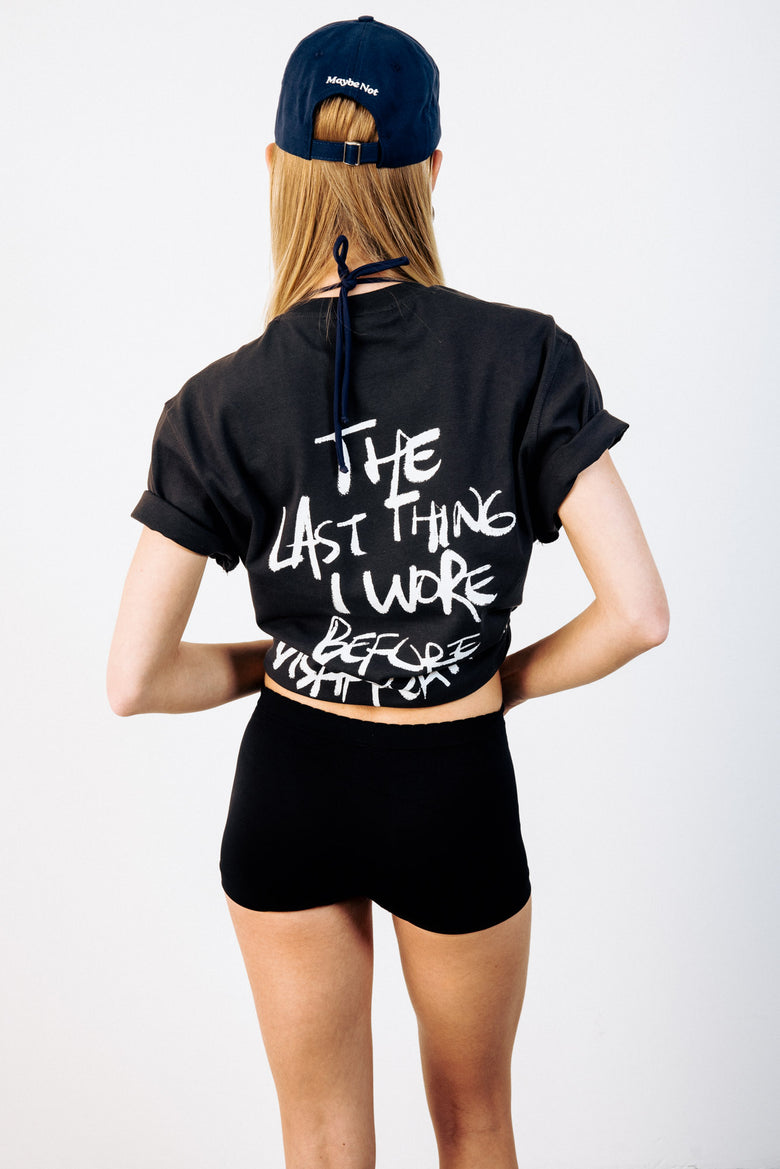
The lower half shifts slightly too: with the volume gathered up top, keeping the ankle visible helps the silhouette resolve. Something plain below the hem — black logo socks, say — counterweights what a chunky knit adds above. In a neutral outfit a cap does comparable work, carrying the centre of gravity a little higher and finishing the top half.
Knitwear is the category that rewards trying things on more than any other. A sweater's cut, the weight of its yarn and where exactly the sleeve ends simply don't come across in a photograph. At the Teşvikiye store on Hüsrev Gerede Caddesi, a short walk from Nişantaşı, handling this season's knits takes about two seconds to show the difference between chunky and fine — and that difference has already decided the rest of the outfit.

