

The Sentence You're Wearing: Why Streetwear Speaks in the First Person
When you read the words on someone's shirt, you credit the sentence to them. Why written pieces almost always speak in the first person, how placement changes the outfit, and how many pieces in one look should talk.
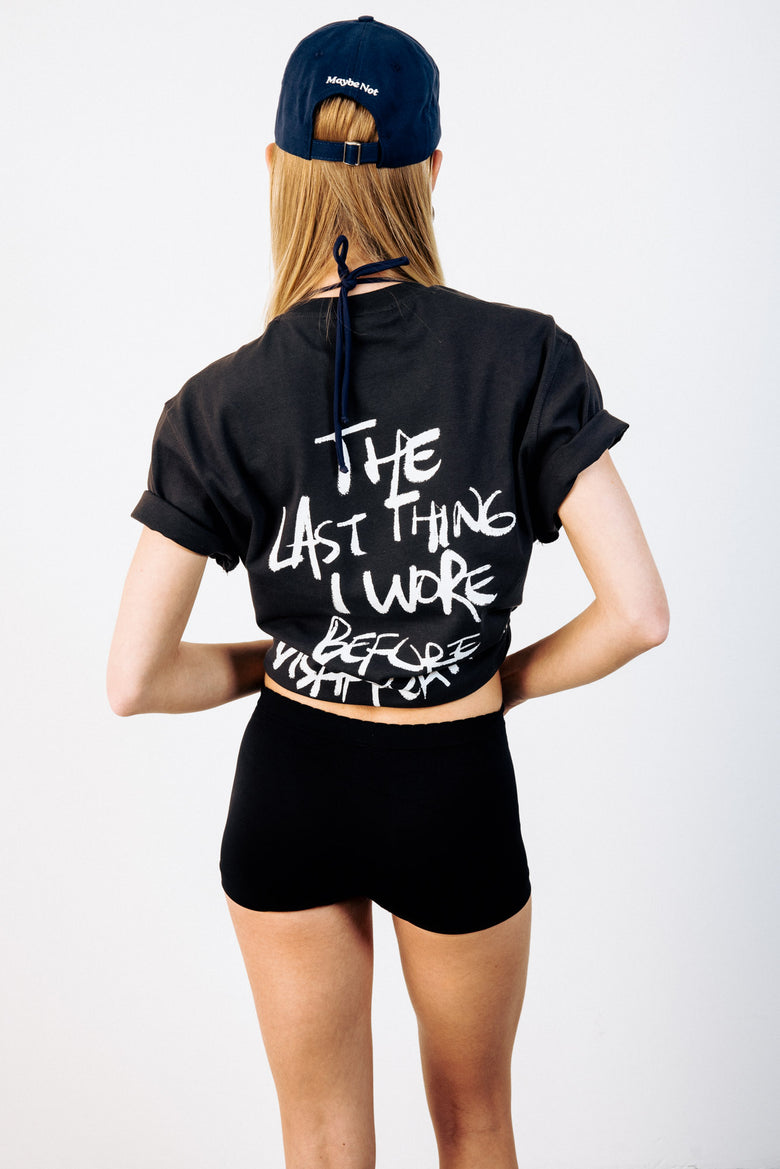
When you read the words on someone's shirt in the street, you do something odd without noticing it: for a second, you assume they said it. Nobody reads a printed line and thinks "this is the brand's opinion." The sentence gets credited to whoever is wearing it. That is the strangest and least discussed part of streetwear — a garment can speak on your behalf.
In a neighbourhood like Nişantaşı, where people size each other up mid-stride, this gets sharper. In the three seconds it takes to pass someone on the pavement, nobody is checking fabric weight. If there is something readable, it gets read first. Choosing a piece with a line on it is really a decision about what you feel like saying that day.
Why is it always "I"?
Almost all of these lines are written in the first person. "I can explain." "Influenced by myself." "I think I think too much." Rarely a command, rarely a universal slogan. The reason is simple. A sentence in the third person sits on a garment like a billboard; in the first person it sits like a confession. People don't want to carry a billboard. They'll happily carry a confession.
That's why something like the I Can Explain cap works. The sentence is unfinished. What exactly is being explained is never stated. Whoever reads it fills the gap, and the gap becomes the wearer's character. The same logic runs through the Away From Myself tee — not a closed statement, but one deliberately left half-open.
Irony as a buffer, not a defence
The second thing these pieces share is that they lower the seriousness by a notch. A Delulu tee or the Potential Patient tee starts by making fun of itself. That isn't a defensive reflex so much as a buffer: once you've made the joke about yourself first, the line loses its edge, and what's left reads as ease.
The same instinct runs softer through hooded pieces. The Overthink hoodie does it in a single word, while Sometimes A Hoodie builds the joke out of the garment itself — a hoodie announcing that it is a hoodie. That kind of humour only lands in streetwear. No other category of clothing writes its own name across its chest and finds it funny.
Where the line sits decides the outfit
Placement changes as much as content. A line across the chest is read head-on, which means you open the conversation. A line on a cap is only legible up close and behaves more like an inside joke. The Text Me cap lives exactly at that scale: invisible from two metres, fully itself from one.
Length matters too. Single words behave like graphics — they don't disturb the silhouette and register as a mark from a distance. Full sentences behave like text, and while the eye follows them the torso reads longer. A shirt carrying a long line therefore balances better over a roomier bottom: if the eye lingers up top, you want volume below it.
How many pieces should talk?
One. Wear two written pieces at once and the two sentences compete, so neither gets read. If someone in the Influenced By Myself tee also has a line on their cap, the outfit produces noise rather than a message.
In practice this means surrounding the talking piece with quiet ones. Plain, unprinted basics exist for precisely this job. A clean black hoodie or a small-logo tee makes the sentence next to it audible. Silence here isn't absence, it's acoustics.
What a foreign language does
A line in a language that isn't the reader's own doesn't lose power — it gains a beat. You judge a sentence in your mother tongue immediately; a sentence in another language hangs in the air one second longer, and that second extends the attention. Part of what the Tutto Passa tee is doing sits there. It's Italian for "everything passes," but it carries a tone even for someone who doesn't know that.
Pieces that speak through gender work in a similar register. The Not Your Boy and Not Your Girl caps set up the same sentence from two directions; both refuse to be claimed, and neither raises its voice doing it.
The one question worth asking
Before size and colour, try this: would I still want to carry this line a year from now? Words leaning on a very current reference date within six months; words built on a way of being don't date at all. That's where the distance between the Overthinker's collection and the Delulu collection begins — one describes a way of thinking, the other a mood, and neither belongs to a season.
The rest is a matter of surface. On the t-shirt side a line spreads across open space; on the cap side it has to fit one row; across sweatshirts and hoodies it can disappear under a layer once the weather turns. Whichever you pick, that sentence will be speaking for you all day. When someone's eye catches it on a pavement in Teşvikiye, you're the one who has to answer for it.

