

Istanbul Streetwear Brands: How a Local Language Gets Built
What makes a streetwear label local isn't its logo: it's how close production sits, how the fit is calibrated to the climate, the tone of the line printed on the garment, and how the shelf is built. An editorial reading of how a local language gets built in Istanbul streetwear.
Istanbul is one of the few cities where a streetwear label can walk to its own production. A pattern goes out in the morning and comes back corrected by the afternoon; a print test can change twice in a single day. It sounds like a logistics detail, but it feeds straight into how a brand speaks. Proximity makes you braver — if you can fix something that didn't come out right without waiting six months, you try more things.
Conversations about Istanbul streetwear brands usually turn into a list: who exists, who launched, who sold out. The more interesting question is what actually makes a label local. The answer isn't in the logo. It's in where the fabric comes from, whose body the fit is calibrated to, how the shelf is built, and what language the sentence printed on the garment was thought in before it was written.
Production nearby means the language is learned fast
A brand sourcing from abroad has to lock a season months in advance. A brand working within an hour of itself, somewhere between Osmanbey and Merter, can change its mind mid-season. The visible result is collections that feel like they're still developing rather than finished.
You read that proximity most clearly in the products where workmanship can't hide. In leather pieces, the seam allowance, the lining choice and the stiffness of the hide all trace back to the relationship with the workshop — a cut like the Old School Leather Jacket only sits properly after the same maker has built it several times over. The same is true of knit: on the knitwear side, the balance between yarn weight and the volume of the pattern doesn't hold without a few rounds on the sample.
Whose sentence is on the garment?
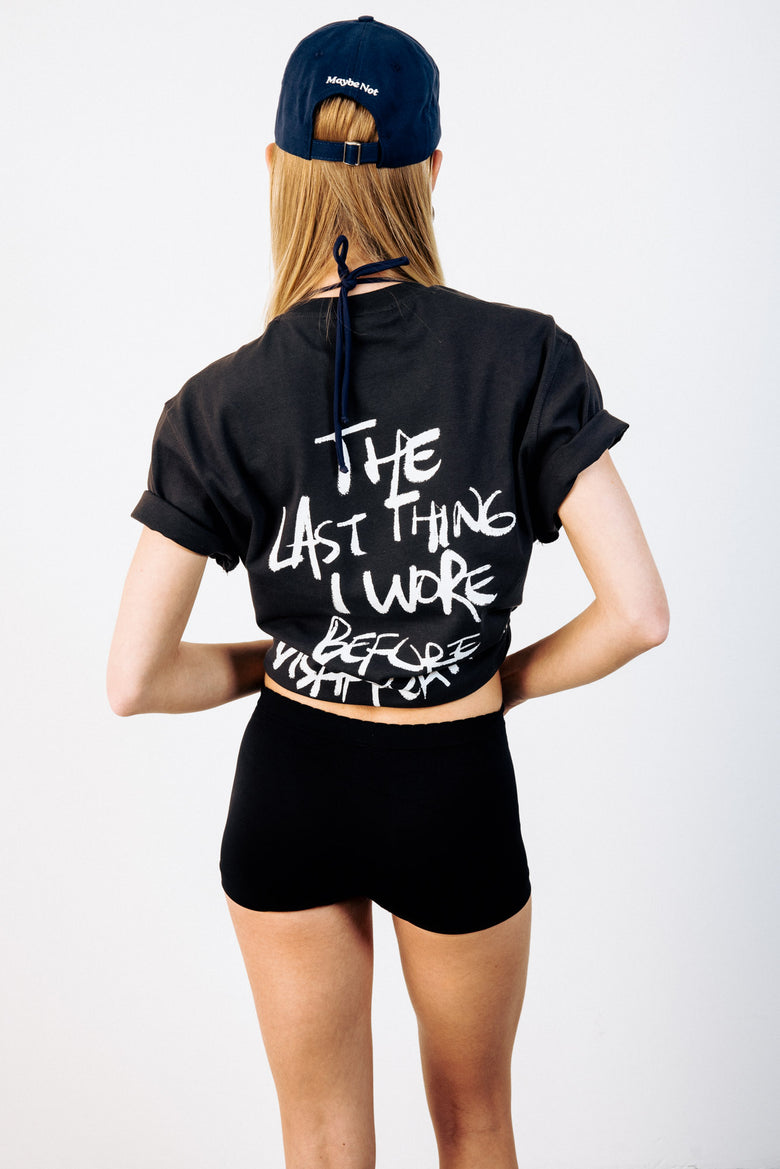
Perhaps the most distinctive thing about streetwear made in Turkey is a text language that writes in English while clearly speaking from here. These aren't translated slogans; they're short lines built out of the shared language of the internet — slightly self-conscious, usually at their own expense. Phrases like I Can Explain or Not Your Boy aren't there to deliver a message; they're there to give the wearer a tone.
Where the text lands is a decision too. A line printed across the chest reads like a statement. The same line embroidered on the front of a cap speaks more quietly, because it sits above the face and is rarely read from a distance. The black Overthinker Cap has stayed in circulation for years for exactly that reason: a piece with something to say that doesn't shout tends to last longer in a wardrobe.
On the t-shirt side the language can be more open — a word like Delulu carries an entire generation's way of joking about itself. An Italian phrase like Tutto Passa shifts to a completely different register on the same rail: same source, different accent.
Fit gets calibrated to a climate and a body
This is the least-discussed side of being local. Istanbul's summer is humid, its winter is wet, and its shoulder seasons are long. Those three facts together push fit decisions somewhere different than they'd go in another city. A loose cut that doesn't cling in humidity is a comfort question here, and spring and autumn stretching over months makes mid-weight tops that work on their own useful for most of the year.
In practice, that extends the life of two garments in particular. In wide-leg denim, a cut like the Cloud Crush wash leaves the leg free enough to wear in heat. On the sweatshirt rail, a half-zip covers the long stretch between March and November on its own, because one movement adjusts it to two different temperatures.
The store is where a collection gets its last edit
When a brand runs its own store, the collection really finishes on the shelf. Which colour goes to the front, what gets hung next to what, which size disappears fastest — all of it is data that shapes the next production run. An online store reports this as numbers. A physical one shows you where people's hands actually go.
On Hüsrev Gerede Caddesi in Teşvikiye, that editing table is visible. The books and objects sitting beside the clothing aren't set dressing; they're a sentence about where the brand places itself. That's also what has shifted in Nişantaşı's concept store culture over the past few years: a shelf now shows not only what's for sale but what the brand is looking at.
A practical way to read a local label
Whether a streetwear brand has actually built a language, or is just a seasonal look, shows up in a few signals.
Does the same piece survive two seasons?
A pattern that stays proves the brand trusts its own archive. A label that replaces everything each season hasn't yet worked out what it does well.
Is stock restocked, or just sold through?
A colour coming back means that piece is settled on the production side. A rail that runs permanently on last-size logic is sourcing, not producing.
Are the materials named?
Listing fabric weight, hide type and yarn blend is work. A brand that publishes it can defend it.
Is there somewhere to stand in?
A cut you can try on is a different commitment than one you see on a screen. When new arrivals hit the shelf the same week they go online, the brand isn't drawing a line between the two.
Streetwear in Istanbul is no longer a borrowed subculture. It has its own production, its own written voice and its own retail culture. The proof isn't in big claims but in small consistencies: a pattern produced for the third time, a line on a cap that's still funny two years later, a shelf that clearly wasn't arranged by accident.

