

Fewer Pieces, More Days — Building a High-Rotation Streetwear Wardrobe
A wardrobe isn't measured by how many pieces it holds, but by how many are actually in circulation. A practical way to build a five-piece core, judged on the tone, cut and care that decide how often something gets worn.
The real measure of a wardrobe isn't how many pieces it holds. It's how many of them are actually in circulation. In most closets that ratio is startlingly low: thirty things on the rail, the same five worn all week. The rest aren't sitting there because they were bad buys. They're sitting there because they can't keep up with the pace of an ordinary week.
What follows is about why those five are always the same five. Not an argument for owning less, and not a sermon about simplicity — just a different question to ask in front of a rail. Instead of “do I like it,” try “how many times will this be on my back this month.”
Rotation is the most honest thing you can measure
In streetwear, a piece usually gets judged at the moment it drops: which series, which print, how many made. Its actual report card, though, gets written six months later. If a tee is still going out twice a week, it was a good buy. If it comes out once a month, its shop-window performance was high and its wardrobe performance was low.
Noticing that gap changes how a whole wardrobe behaves. High-rotation pieces are the spine, and they're usually the ones nobody talks about. The low-rotation ones tend to be the most admired — they're just waiting for an occasion, and the occasion never quite lands on a Tuesday.
Three things high-rotation pieces have in common
Tone matters more than colour
What drives rotation isn't the colour itself but how many neighbours that colour can get along with. Off-white, grey marl, washed black and a mid-depth brown pick almost no fights with the rest of a closet. Saturated, bright colours work well, but they're selective — wearing them usually means building the rest of the outfit around them.
The difference is easy to see on the tee rail. The quiet ground of the Locker tee, or Away From Myself in milky white, asks nothing of whatever goes underneath it. The Market tee in white belongs to the same category: there's a graphic, but the ground stays calm, so adding a layer over it doesn't break anything. Splitting the tee selection into these two groups tells you in advance how often each print will actually get worn.
The cut works over two different bottoms
The second test is geometric. If a top only looks right over one kind of bottom, its rotation is tied to that bottom. High-rotation tops hold their proportion over both a loose denim leg and a softer, heavier-draping sweatpant.
Full-zip styles usually pass this test, because open they behave like a layer and closed they behave like a top — one piece, two silhouettes. The washed black full zip is the plainest version of that. For a warmer mid-tone, the Bunny full zip in brown does the same job from the brown side of the palette. When you want a slimmer body and no hood, a washed grey sweatshirt slides in above or below another layer without complaint. Reading the sweatshirt and hoodie rail this way separates pieces that look nearly identical on the hanger.
Care doesn't cost a day
The third point is the least romantic and the most decisive. Anything that won't be ready by the next morning, needs pressing, or waits on a special cycle quietly drops out of rotation. A piece you can wear twice a week is, in practice, a piece that dries in two days.
Building a five-piece core
The core comes together on a simple count: two tops, two bottoms, one finisher. Linked properly, those five reduce almost every weekday to a single decision.
Down below, the rule is to keep two levels of stiffness — one woven, one knitted. A dark, barely-washed loose fit jean gives an outfit structure, though it gets heavier as the day goes on; cargo lounge pants in grey marl build the same silhouette for considerably less effort. If you want the tone slightly more formal, a navy loose fit jean works better than black once the evening starts. That pairing comes together easily between the denim rail and the sweatpant selection; seen across the full bottoms range, the differences in cut become much clearer.
The fifth piece — the finisher — is often the smallest decision. A lighter top like the Moodboard hoodie in white pulls the visual weight of an otherwise dark outfit upward.
The extremities quietly do the rest
The cheapest way to widen a wardrobe's rotation is at the head and the feet. The same five pieces worn twice in a week stop reading as a repeat once the cap and the socks change.
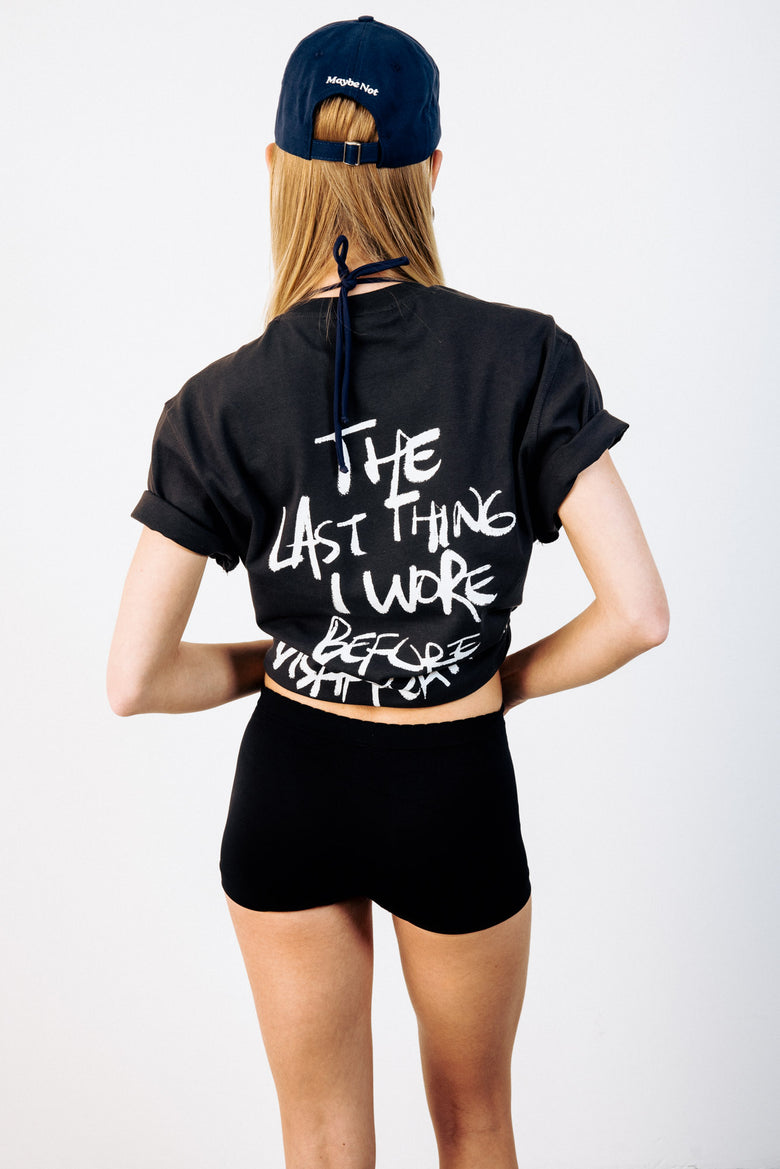
A plain black Not Your Boy cap reads as a continuation of a dark outfit, while the Hi Mom cap in off white lifts the same clothes a tone higher — which is why the colour range across the cap wall is deliberately broader than the core. Lower down, a single light tone like the off-white logo socks creates a visible break under a dark hem. The sock selection isn't an afterthought to the core; it sits in the middle of it.
Low-rotation pieces usually fail for one of three reasons
When something drops out of the rotation, it's generally because it forces the rest of the outfit to be built around it, works in only one narrow band of weather, or leaves a care debt every time it's worn. None of that makes a piece bad. It just makes it part of the outer ring rather than the core.
A healthy wardrobe has both rings: a small number of pieces that turn over every week, and a set that comes out once a month but carries the whole look when it does. The trouble starts when the outer ring gets mistaken for the core.
A two-week count
There's a practical way to measure this. For two weeks, write down every piece you wear as a single line on your phone. By day fourteen the list splits itself in two: names that appear more than once, and names that never appear. The first group tells you what the next purchase should look like. The second tells you what not to repeat.
Carrying that list around Nişantaşı and Teşvikiye changes the decision you make standing in front of a rail in a concept store. Liking something is easy. Knowing which day of the week it will land on is the skill that keeps a wardrobe alive for years.

