

Rabbits, Dragons and Mountains: What Drawn Characters Actually Do in Streetwear
Why do the figures a label draws outlive its logo? From caps to knitwear, how character pieces work in streetwear — scale, colour count, and how many figures can share one outfit.
You don't need to have seen a figure before to recognise it. The rabbit on someone's cap as they come towards you on the pavement lands somewhere in your head even if the label means nothing to you: small, linear, faintly stubborn. Text doesn't work that way. Text asks to be read, and reading asks for the distance to close first. A drawing never asks.
That's the reason characters last so long in streetwear. A rabbit, a dragon, a mountain outline — it ends up being the one element a label doesn't have to re-explain every season. Cuts change, the colour card moves somewhere else with every collection, even the logo shrinks and grows. The figure stays, and every season it stays it becomes a little more familiar.
A drawing is recognised before a word is
The eye always works through an outfit in the same order: silhouette first, then the block of colour, then whatever is drawn on the surface, then any text. Nobody decides that order; it is just the speed at which seeing happens. So a piece carrying a character enters third, independently of everything else in the outfit, and usually becomes the detail people remember.
The practical consequence is simple. A character piece doesn't have to be the main sentence of an outfit, but it is already a candidate for the line people quote back. Dressing with that in mind mostly means not leaving the figure exposed — everything next to it should sit a little quieter.
The same figure says different things on different surfaces
A character draws its power from repetition, but its tone shifts with every surface it repeats on. The same drawing reads as casual and offhand across the front of a cap; moved onto a shirt it becomes something placed rather than worn; pressed into leather it has stopped joking altogether.
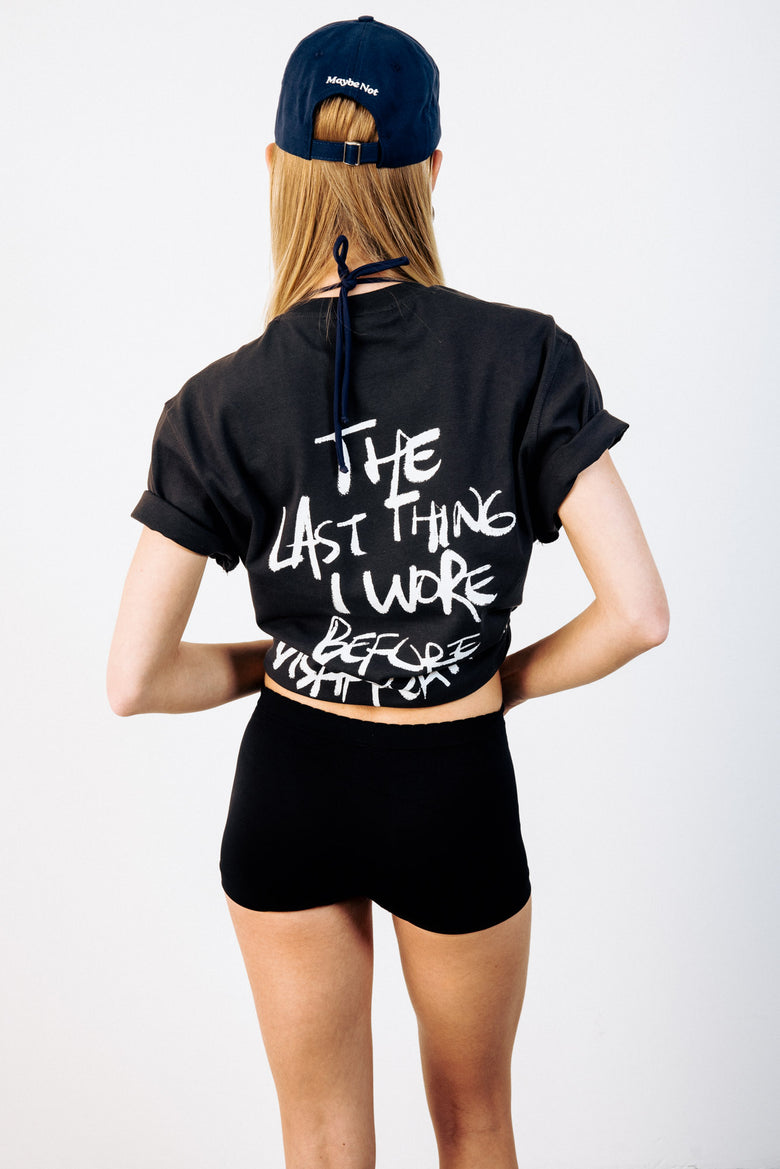
The rabbit makes this easy to see. On the black Bunny Cap it works like a daily mark, small and unbothered. The same rabbit carried onto a shirt moves to the centre of the outfit and asks everything underneath to simplify. Headwear gives you more room to be playful, because a drawing at eye level takes up far less space than one across the chest — which is broadly how the cap selection is built in the first place.
With the dragon it's entirely a question of the weight of the surface. The dragon leather jacket puts the same kind of figure on something hard and reflective instead of matte cotton, and that alone makes it far more assertive. This is a piece that prefers to speak alone in an outfit; the plain single-colour tee underneath it isn't a coincidence, it's a requirement.
Where a character piece starts looking childish
Drawn figures earn their bad reputation in streetwear at exactly two points: scale and colour count. Once a character grows large enough to cover the whole chest and carries more than four colours, the piece slides quickly towards toy-shelf territory. The same figure at a smaller scale, worked in two or three colours, does the opposite.
The second break point is the cut. Put a slim leg under a character piece and the drawing genuinely starts reading as costume. Put something with weight and a proper drop under it and the figure settles. The black Lucky Hoodie is one of the pieces that holds this balance — the volume of the hoodie carries the figure, rather than the figure carrying the hoodie.
The third is context. The same graphic hoodie goes somewhere completely different with trainers and sweatpants than it does with a straight trouser and a leather bag. The character hasn't changed; the level of seriousness around it has.
How many figures fit in one outfit
The answer is almost always one. Two different characters in the same outfit weaken each other, because the eye can't work out which one is the main idea. A rabbit on the cap and a mountain on the sweatshirt is two separate stories being told at once.
The single exception is the same figure appearing twice. When one character sits small on the cap and slightly larger on the upper body, it reads as deliberate rhythm rather than collision. Pairing the green-ground version of the rabbit with a top carrying the same figure will always look more collected than putting two unrelated characters side by side.
Autumn moves the figure off cotton and into knit
In the last week of September characters change address. Through summer the figure sat on thin cotton, in a single layer. As the air cools the same job moves to the outer layer, and this time the figure comes out of the texture itself — not printed on, but knitted in.
Knitwear shows this most clearly. The baby blue mountain knit builds the figure together with the stitch instead of adding it to the surface, which is why the same drawing reads far quieter here than it would on a printed tee — and why it stays wearable much longer. The selection where the mountain and monster figures sit together and the knitwear side do the same work through autumn: they turn a character from graphic into texture.
The sweatshirt and hoodie side, doing second-layer duty in the in-between weeks, sits at the midpoint — between the ease of cotton and the weight of knit, in the range where a figure still reads clearly but no longer looks like summer.
Closing
The figures a label draws become its off-season memory. Pieces sell through, colours don't come back, cuts get replaced — but someone who has recognised the rabbit once will recognise it again on the pavement two seasons later. That's also why, in the Teşvikiye store on Hüsrev Gerede Caddesi, you can see the same figures running from the cap wall through to the knitwear: in a concept store, what ties the shelves together is usually not colour or category but that one small recurring drawing.
If you're putting together a streetwear look around Nişantaşı, treating the figure as the most consistent part of the outfit works better over time than making it the loudest. Pick one character, leave it room, keep the rest quiet.

