

Can You Wear White After Summer? Off-White's Second Life in Autumn
Packing away pale tones at the end of summer is an inherited habit, not a rule. The difference between optic white and off-white, where a light colour belongs in an outfit, the surfaces that carry it, and three setups that run from September into November.
The second half of September is when wardrobes rotate. Pale things move to the back, dark things come forward. Almost nobody thinks it through — it's a reflex built on the assumption that white ends when summer does. But what actually pushes a colour out of season isn't the colour. It's the fabric it sits on and where it lands in an outfit.
And in Istanbul, late September still hits twenty-six degrees by midday. It's early for a fully dark wardrobe. The question isn't whether to retire pale tones; it's where they sit once the light changes.
Where the rule came from
"No white after summer" started as a calendar, not a judgement about taste. In early twentieth-century America the season split along city and country lines: linen and white out of town, dark wool in the city. Wearing white after the first Monday in September signalled you hadn't come back yet. It was a class marker, not an aesthetic one.
That distinction has no equivalent today. The rule outlived its reason and turned into habit. You can still trace it in streetwear: most photographs taken in September have a black, grey or navy upper body. The narrowness of the autumn palette isn't a requirement — it's an inherited shortcut.
Optic white and off-white are not the same colour
Pale tones don't all behave alike. Optic white — cotton treated with brighteners, leaning slightly blue — looks clean in summer light. Once the sun drops lower the same white hardens, and the contrast against skin gets sharper than it was in August.
Off-white leans yellow and grey instead. Low autumn light doesn't sharpen it, it softens it. There's a quick way to check: put the piece next to a camel cap or a brown leather surface. If the tone is warm, the two sit together. If it's cold, the white reads blue and pushes the other colour away.
The difference is visible on the t-shirt rail. One off-white tee with cream in it and a milky white next to it are the same category at different temperatures — one has cream in it, the other is milkier and softer. A plain white tee sits on the true-white side, which in autumn works better underneath a layer than on its own.
Where a pale tone belongs in an outfit
How high a pale colour sits decides how much risk you're taking. On the upper body it opens up the face, but it also pulls the torso forward — in a boxy cut the chest reads wider than it is. If that's not what you want, dropping the colour one level down solves it.
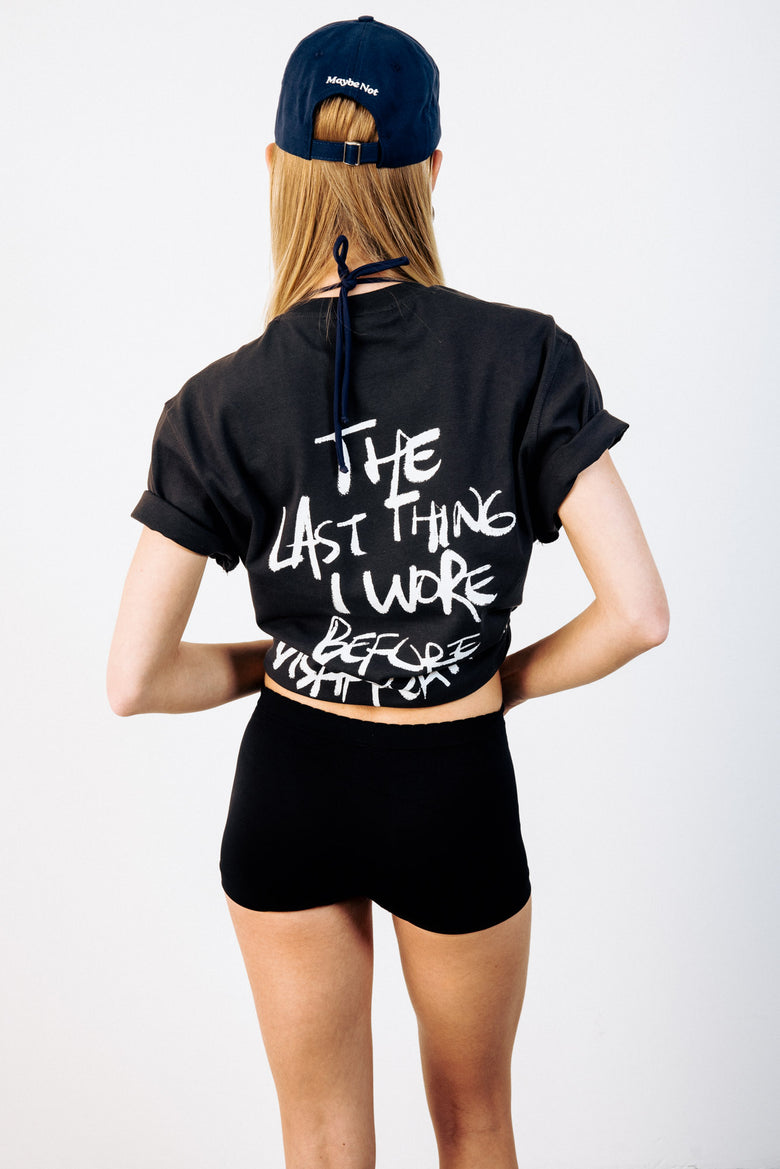
The lowest-risk position is accessory height. An off-white cap holds its own inside an otherwise dark outfit and nobody calls it summery. An off-white cap or the embroidered version of the same tone both do that job: the rest can stay entirely dark and there's still a break at the top. The same logic works at the ankle — white logo socks leave a gap between hem and shoe that stretches the line instead of cutting it.
Camel is the middle route. Not quite white, not quite earth. A camel cap is one of the few pieces that does the same job from September through November, because it agrees with pale tones and a dark outer layer at once. For anyone who wants to see the whole range, the headwear selection is spread across exactly those two ends.
Surface carries the colour
What season a colour belongs to has less to do with the tone than with the surface it's printed on. The same off-white looks like summer in thin jersey and entirely like autumn in a heavy knit. Light scatters when it hits a matte, lofty surface and bounces back off a flat one. What your eye reads as "that's a summer piece" is usually just returning light.
Which makes knitwear the shortest route into autumn. The off-white Mountain knit relocates the colour completely through gauge and raised pattern; Monster is the more graphic option in the same tonal family. Pale blue belongs under the same heading: the baby blue version of the same knit is a light colour, but the matte wool carries it comfortably into November.
The second surface is brushed fleece. A white hoodie or a white sweatshirt reads far heavier than the same colour in a tee. That's why most of the white pieces on the sweatshirt and hoodie rail come out before the t-shirts do.
Is a pale shoe a mistake in autumn?
White sneakers usually get shelved for two reasons: dirt and seasonality. The second one is largely solvable, because a single-tone white shoe and an off-white-plus-sand combination aren't the same proposition. The off-white and sand colourway of the Adistar Control 5 falls into the second group — the off-white mesh is broken up by sand on the sole and trims, so the eye doesn't file it as a summer shoe. The volume of a technical running silhouette also sits better under autumn hems than a slim summer pair.
For the dark end of the same palette there's the earth-tone Handball Spezial: suede, earth tone, low profile. They're really two ends of one colour line and can be alternated across a season. Because the sneaker selection is kept narrow, that distance is easy to read straight off the rail.
Three setups that run into November
Tone on tone. Off-white knit, a light-wash loose fit jean, dark shoe. Top and bottom at the same temperature, the shoe closing the account. It looks like the hardest one and takes the least effort.
One opening. Dark from head to toe — a black washed black hoodie, dark denim — and a single off-white point: cap or socks. Two minutes in the morning, and nothing about it can go wrong.
Open through the middle. A dark outer layer, a white sweatshirt under it, raw rinse denim below. Unzipped, there's a vertical white strip; closed, the outfit goes fully dark. The only one of the three that gives you two looks in a day.
Whether a pale tone works in autumn is not something a shop window answers. Store lighting makes every off-white look warm; the real test is a few steps outside, in daylight. When you try one on at the Hüsrev Gerede store it's worth walking out the door for a moment — the light on the Nişantaşı side turns in the afternoon, and the same knit can be two different colours two metres apart. The pale tone worth keeping until November is the one that survives that gap.

